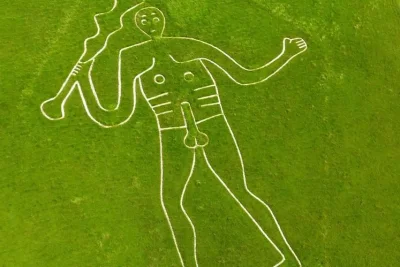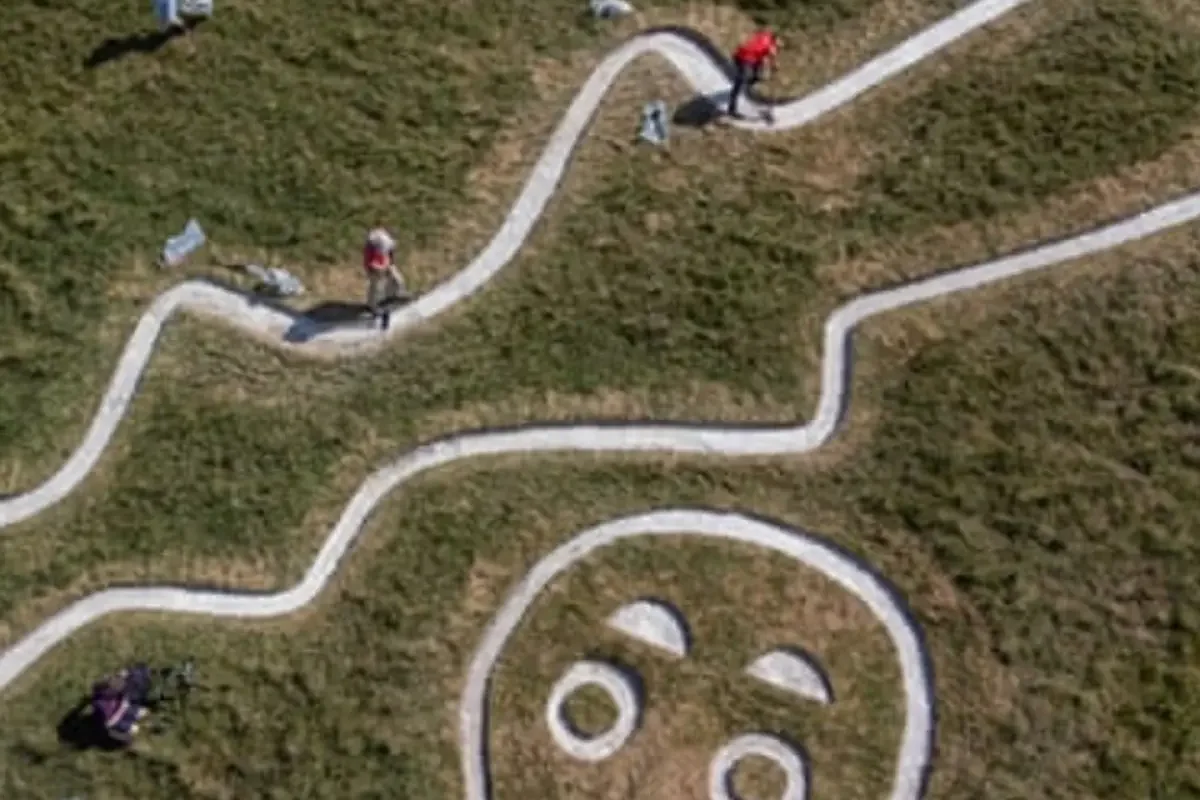
National Trust staff and volunteers began packing 17 tonnes of fresh chalk onto the Cerne Abbas Giant in Dorset this week to restore its fading outline.
The conservation charity moved the scheduled maintenance forward to May after changing weather patterns caused rapid algae growth and severe erosion on the 55-meter prehistoric figure.
>>> A24's 'Backrooms' Horror Film from YouTube Creator Kane Parsons Hits Theaters
Heavier winter rains and milder summers have accelerated the deterioration, prompting the early intervention.
To combat the steep one-in-three gradient and prevent the fresh material from washing away, workers are trialing a new technique by mixing the chalk with water to create a paste resembling plaster of Paris.
Lead ranger Luke Dawson stated that increased moisture has caused a dulling effect on the giant, leaving it greener and less distinct between regular maintenance cycles.
"It's one of these things we cannot really prove," Dawson said. "It is more just observation of what we are seeing up there."
The ranger noted that the traditional process of hand-packing the chalk has kept the historic landmark visible for centuries.
"It's how we have kept him visible for centuries," Dawson said.
He explained that the modern world is affecting the hundreds-of-years-old figure, requiring adaptive management strategies.
"The giant is hundreds of years old but the modern world is certainly affecting him," Dawson said.
Warmer, wetter conditions create ideal environments for algae to dull the bright white lines, he added.
"We've noticed algae growth starting to dull the giant's bright white outline.
We can't say for certain what's driving that, but warmer, wetter conditions may be a factor," Dawson said.
"The milder winters and wetter summers make perfect growing conditions."
Dawson indicated that the trust might need to adjust its historical timeline and increase the frequency of the restoration work.
"It may be we have to adapt and perhaps rechalk more often," he said. "We will also explore ways to retain more water within the landscape."
Dry chalk application on the steep slope proved highly difficult during previous attempts in 2008 and 2017.
"But that's very difficult because the hill is so steep," Dawson said.
The current paste method aims to provide better adhesion to the hillside.
"It's like a putty, which makes it easier to make it stick," he said.
Despite the physical toll of the heat, Dawson highlighted the deep community connection to the hillside figure.
"It's a beloved figure," Dawson said. "Everyone in the village has a connection with the giant."
He recalled that heavy precipitation during the previous restoration in 2019 quickly degraded the fresh chalk lines.
"The erosion was in part because of that September rain," he said.
>>> Police Investigate Apparent Murder-Suicide in North Hills That Left Four Dead
Winter conditions fail to clear the growth when temperatures remain mild.
"If that algae does not get killed off over winter, coupled with the fact that we're getting wetter summers, it just promotes that algal growth in damp conditions," Dawson said.
Volunteers who secured spots through a National Trust lottery worked on the giant's limbs during some of the hottest weather of the year.
"We did not know it was going to be one of the hottest days of the year," laughs Chloe Baugh, a volunteer.
She reflected on the generations of workers who maintained the site before her.
"It has really made me think of all the people that have worked to do this over hundreds of years," Baugh said.
International volunteers also joined the project following a nationwide fundraising appeal that secured adjacent lands.
"But this is so special, so English," said Debby van den Berg, a 51-year-old civil servant from Gouda in the Netherlands.
She noted the unique public presentation of the figure compared to continental European sensibilities.
"We think of the Brits as reserved but I don't think this figure would have survived in Holland," she said.
Participants utilized manual tools to clear the older, discolored layers from the chalk grassland.
"It's lovely to be part of something so special," said Jane Hanney-Martin, a museums manager from the West Midlands.
She described the physical challenge of moving the excavated materials away from the figure.
"Lumping the old chalk uphill to get it away is hard work but it's worth it," she said.
Veteran staff observed long-term environmental shifts over decades of managing the Dorset landmark.
"Last time, we did the rechalking in the late summer/early autumn and the rain washed a lot of it away.
We get complaints when he's not as bright as people want," Dawson said.
"The warm weather should dry out the chalk paste nicely and hopefully he'll just about be as good as new again when we're done here."
National Trust managers explained that historical gaps exist regarding when the giant was visible to locals.
"One theory is that during that period, the grass grew back.
So maybe during that period he disappeared and no one was aware that he was there until that 1600s period," Dawson said.
"But we still don't know why he's there and why they created him and that's a mystery."
>>> Patagonia Sues Drag Queen Pattie Gonia Over Trademark Infringement
The restoration project takes place following a successful sixty-day campaign backed by Sir Stephen Fry that raised 330,000 pounds to purchase 138 hectares of surrounding land, ensuring habitat protection for the endangered Duke of Burgundy butterfly.