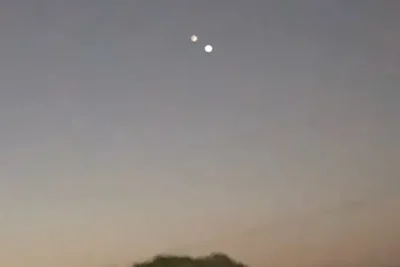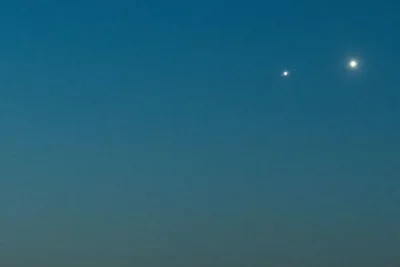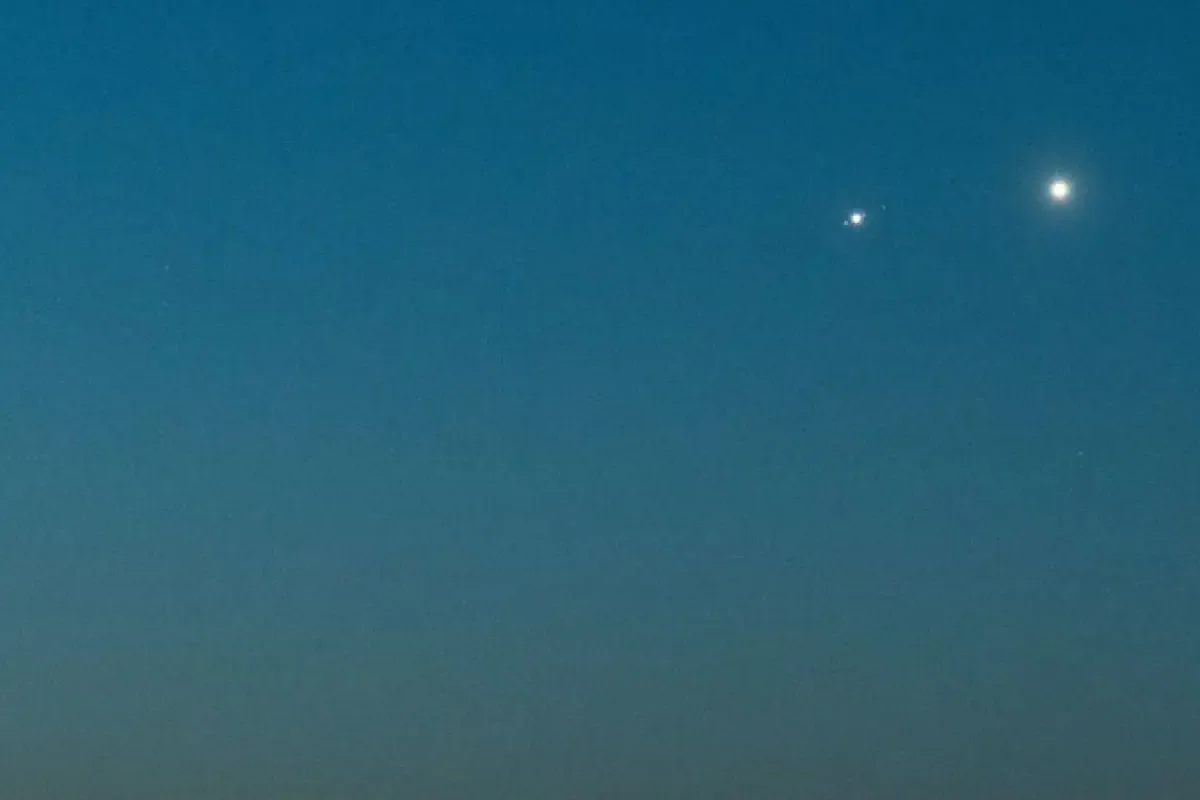
Venus and Jupiter will align closely in the western night sky on June 9, 2026, creating a rare planetary conjunction visible to the naked eye shortly after sunset.
As reported by Fox Weather and Space.
>>> Bystanders Restrain Knifeman During Violent North Belfast Stabbing
com, the two brightest planets will appear just 1.5 degrees apart during twilight, though they remain millions of miles apart in reality.
Skywatchers can observe the phenomenon by looking toward the western horizon between 45 minutes and two hours after sunset before the planets drop below the horizon.
Why Planets Align
The apparent proximity of the planets results from Earth's flat-disk orbital structure, which aligns the planetary paths along a single plane known as the ecliptic.
According to researchers, this stable, circular configuration prevents extreme climate shifts on Earth and maintains the conditions necessary to sustain liquid water and life.
"The Earth's orbital plane is only tilted a little relative to the average plane of the solar system, called the invariable plane," said Kat Volk, a planetary scientist at the Planetary Science Institute in Tucson, Arizona.
Volk noted that the concentric alignment reflects the ancient formation of the solar system from a rotating disk of gas and dust that surrounded the early sun.
"That's why, as we're watching them in the sky, they're all kind of following a path along the ecliptic plane," said Volk.
While many distant exoplanetary systems feature wonky or highly inclined orbits due to stellar interactions in crowded star clusters, the solar system retained a flat structure.
Massive bodies like gas giants stabilized the inner orbits after migrating through space.
>>> London Police Investigate Fatal Stabbing of Musician Talay Riley
"When the sun was being born out of some cloud of gas and dust, it was collapsing down to form the star.
Then, angular momentum caused the material surrounding that [star], that didn't make it into the sun, to form a disk that is rotating and orbiting around the star.
The really massive bodies in the solar system — the planets — tended to form within that disk," said Volk.
Volk warned that observers on other planets might not experience the same orderly cosmic arrangement because many stars form in clusters where stellar interruptions alter planetary angles.
"If there's another Earth out there, there's no guarantee that the observers on that 'Earth' would see the same kind of nice ecliptic plane that we see in our solar system," said Volk.
Elongated or unstable orbits would fluctuate the intensity of sunlight received by a planet, complicating its climate patterns and potentially threatening habitability.
"If our planet's orbit was really elongated, you'd have different intensities with sunlight throughout the year. That would be an additional complication on the climate," said Volk.
Analyzing these unique orbital paths provides scientists with deeper insight into the rare combination of environmental factors that allow Earth to remain a habitable planet.
"Orbital dynamics allows you to start to think about all those fun, different aspects of what makes our planet habitable, and ask how normal it is to have a habitable planet," said Volk.
>>> Fireworks Explode After Truck Catches Fire on Tennessee Highway
The planetary alignment remains visible for roughly an hour each evening this week, with the next accessible Venus-Jupiter conjunction scheduled to occur in November 2028.