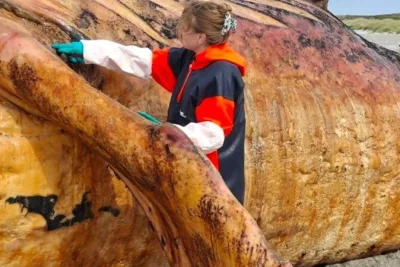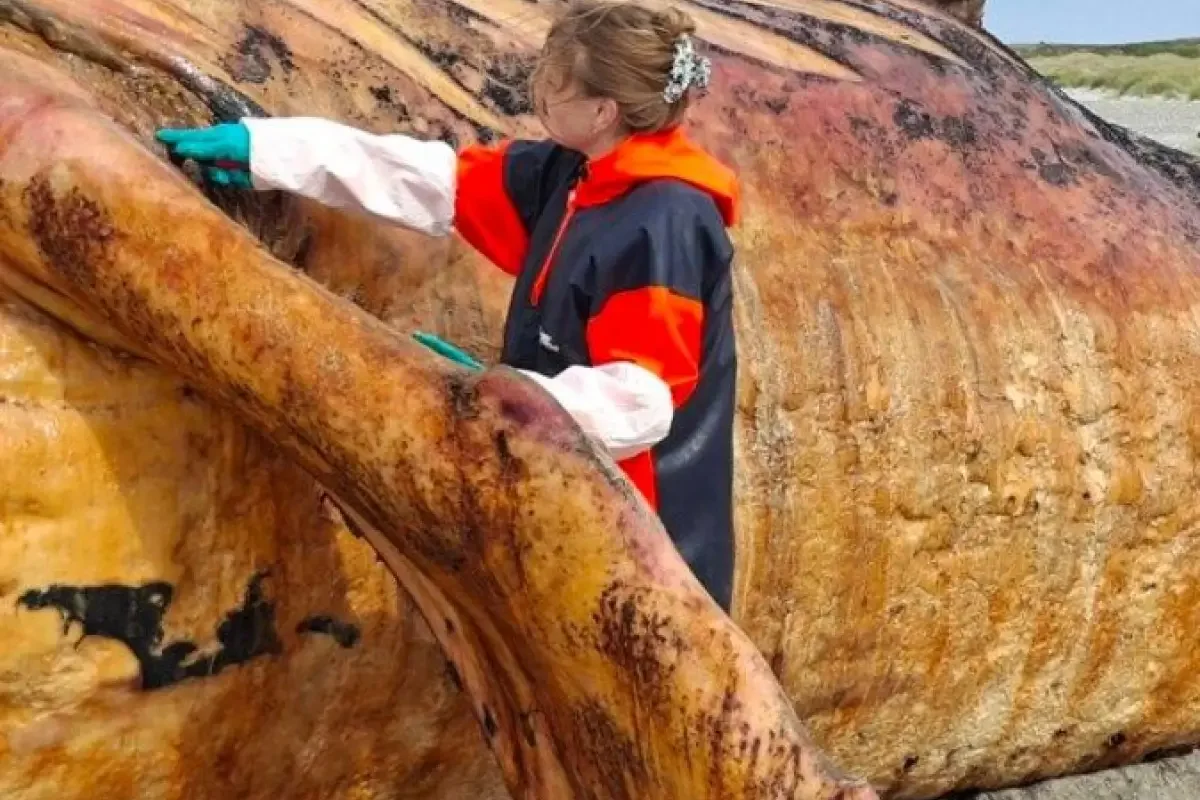
Scientists completed the autopsy of a four-to-five-year-old female humpback whale named Timmy on the Danish island of Anholt on June 3, 2026, to determine its cause of death.
Reporters present during the six-hour examination noted a severe odor as researchers cut open the carcass with a long knife to release trapped gases.
>>> IndiGo Suspends Flights to Six International Destinations from July
The examination took place on the beach because the heavily bloated animal could no longer be moved to a harbor on the Danish mainland.
Local authorities kept onlookers at a distance during the procedure due to the persistent risk of gas accumulation causing the whale to explode.
Initial hypotheses from the German newspaper Bild suggest a fishing net found inside the body may have contributed to the whale's death.
Investigators also discovered parasites in the kidneys, though their impact remains unclear, and sent samples of the heart and brain to a laboratory for results expected in six months.
Historical Parallels with 1997 Sperm Whale Beaching
The physical challenge of managing decomposing marine mammals mirrors historical events on the Dutch island of Ameland, where four sperm whales beaching in 1997 created a major logistical and public spectacle.
Former Ameland Mayor Roel Cazemier recalled the sudden influx of thousands of tourists requiring extra transportation to the island before the dissection began.
"I had net tegen mijn vrouw gezegd: mooi, ik heb dit hele weekend niets in de agenda.
En toen kreeg ik telefoon: een potvis op het strand," said Cazemier.
The unexpected arrival of multiple massive deep-sea creatures created a surreal atmosphere for the local community.
Cazemier noted that the island decided to distribute the carcasses to various regional nature centers and museums that requested them.
"Het is altijd zonde als een potvis doodgaat," said Cazemier.
Despite the tragedy of the beaching, the former mayor acknowledged the unique nature of the event for the island.
He expressed satisfaction that the specimens could be preserved locally for educational purposes.
"Maar als het dan toch gebeurt, dan graag op Ameland," said Cazemier.
The preservation effort required immediate coordination with museum officials to secure the remains.
Nature Center Director Joop de Jong acted quickly to claim one of the specimens for the island's collection.
"Het was geweldig, het was surreëel. Een dier van 13 meter lang uit de diepzee ligt ineens op ons strand.
En niet één, maar vier!" said Cazemier.
The sudden acquisition forced the municipality to alter its existing infrastructure plans to accommodate the massive skeleton.
Cazemier explained that the ongoing museum expansion designs had to be completely reworked to include a dedicated whale hall.
>>> ITV Reschedules Coronation Street and Emmerdale for Football Broadcasts
"Eerder die week waren we akkoord gegaan met de nieuwbouw van het natuurcentrum. Alle tekeningen waren al klaar.
Maar directeur Joop de Jong zei al snel tegen mij dat hij voor het karkas van een van de potvissen ook een ruimte moest hebben.
Dus we konden opnieuw beginnen," said Cazemier.
During the 1997 operations, regional media outlets deployed teams to document the rare event.
Reporter André Minkema from Omrop Fryslân recalled changing his schedule rapidly to cover the developing story on the beach.
"Ik zou die dag heel ergens anders heen," said André Minkema, Reporter for Omrop Fryslân.
The journalists arrived to find the team working under volatile conditions as internal temperatures inside the whales rose.
Minkema described the specific sounds indicating that a gas buildup was reaching a critical point.
"Een of ander saai verhaal.
Toen kregen we de melding dat een potvis was aangespoeld, dus zijn we snel naar het eiland gegaan," said Minkema.
As scientists made an initial incision to vent the built-up air, the internal pressure caused a sudden rupture.
The resulting blast sent debris across the immediate area, startled the research team, and was captured on film.
"Die potvissen begonnen van binnen te koken," said Minkema.
The footage of the exploding organs was subsequently broadcast globally by international networks, including CNN.
The immediate area was evacuated by tourists as the severe smell and debris coated the beach.
"We stonden vlakbij om dat te filmen. En toen gebeurde het opeens.
Het was net een mitrailleur, zo klonk het. De darmen spatten eruit.
De onderzoekers schrokken er zelf ook wel van," said Minkema.
A multi-agency cleanup involving municipal workers, forestry services, and a specialized processing facility cleared the beach within days.
In Denmark, crews used an excavator to cut Timmy's carcass into pieces and load them into containers for removal from Anholt island.
>>> Andrew Stanton Returns to Direct Toy Story 5, Bringing Classic Toys into the Digital Age
"De ingewanden van heel veel lucht vlogen het strand op. De stank was enorm, dat is mij het meeste bijgebleven," said Minkema.