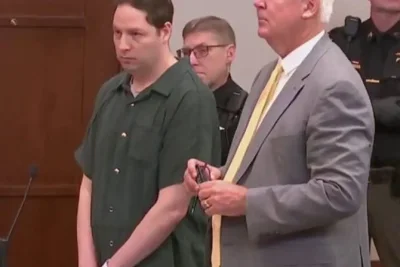
Southampton Crown Court sentenced 23-year-old Vickrum Digwa to life in prison with a minimum term of 21 years on Monday, June 1, 2026, for the fatal stabbing of university student Henry Nowak.
The incident occurred on December 3, 2025, in Southampton, England, where the 18-year-old finance student from Essex was stabbed five times by Digwa using an eight-inch blade.
>>> Jon Stewart Returns to The Daily Show Desk for June 2026 Lineup
Responding police officers handcuffed Nowak as he lay dying, following a false claim by Digwa that the teenager had racially abused and attacked him.
The case has generated intense national scrutiny.
A jury convicted Digwa of murder after a trial that drew commentary from prominent political figures and community organizations regarding police procedures and religious weapon exemptions.
Judge William Mousley KC rejected the defendant's claims of racial provocation, stating inside the packed courtroom that Digwa brought shame upon his family and his religion.
The judge noted that Digwa was sober during the attack and carried a large Sikh dagger, which created widespread anxiety within the local community.
The court heard that Digwa inflicted an enduring loss on the victim's family, who subsequently released body-worn camera footage of the emergency response through the Crown Prosecution Service.
The victim's father, Mark Nowak, expressed profound grief outside the courthouse, contrasting the respectful treatment Digwa received with the handling of his dying son.
He criticized the operational choices made by the emergency responders during the chaotic street scene.
"Henry should not have died on the streets of Southampton in police custody," said Mark Nowak.
He described the immediate detention of his injured son as deeply improper under the circumstances.
According to the father, the teenager was never given the appropriate medical priority or dignity by the attending personnel.
"Henry did not die with dignity. He did not die with the care he deserved.
He lost consciousness before anyone believed him," said Nowak.
He demanded a full, fearless, and transparent external review into how the Hampshire and Isle of Wight Constabulary managed the emergency scene.
The family maintains that navigating the legal system has added an unnecessary burden to their bereavement.
During the sentencing hearing, the father shared his internal emotional struggles regarding the loss of his son.
He expressed final words of remorse directly to his deceased child in front of the court gallery.
"I couldn't help Henry in his final moments and there is nothing I can do to bring him back," said Mark Nowak.
The emotional address concluded with a direct apology to the victim.
Prosecuting barrister Nicholas Lobbenberg KC detailed the defendant's collection of weapons and condemned the false narrative given to police officers.
The prosecutor argued that the false allegations of racial assault exacerbated the family's suffering.
British Prime Minister Sir Keir Starmer addressed the conviction publicly on the social platform X, calling the circumstances deeply troubling.
He acknowledged the family's ordeal and validated the ongoing independent investigation into police conduct.
"Henry's loved ones have gone through the trauma of a long trial and endured Henry's killer making up appalling claims about their son who was thoughtful, kind and deeply loved," said Starmer.
He emphasized that the state must address wider societal issues concerning knife violence.
Hampshire Police and Crime Commissioner Donna Jones described the emergency response failures as a profound systemic issue.
>>> Hawaii Police Charge Jacob Daniel Baker With Three Counts of Murder
She stated that the failure to recognize the victim's critical medical condition was devastating.
The official confirmed that any procedural recommendations arising from the watchdog investigation would be fully adopted.
"The details of the police response raises serious concerns about police impartiality, fairness and judgement," said Jones.
Alan Mendoza, executive director of the Henry Jackson Society, suggested to Fox News Digital that ideological biases influenced the officers' immediate assessments.
He argued that the immediate focus on a potential hate crime distracted from basic investigative procedures.
According to Mendoza, the system failed to establish elementary facts before detaining the dying student.
He noted that while traditional faith items are protected, the defendant possessed non-traditional weaponry.
Temporary Deputy Chief Constable Robert France issued an official apology via Sky News regarding the restraint of the victim.
"I'm sorry that he was handcuffed and arrested in the moments before he lost consciousness," said France.
Reform UK Member of Parliament Robert Jenrick stated on GB News that the attending officers committed a severe error in judgment.
"The officers chose to prioritize the accusation of racial abuse over saving the life of this young man," said Jenrick.
He further criticized the initial public silence from senior government executives regarding the tragedy. "The Prime Minister says absolutely nothing.
The Home Secretary says absolutely nothing," said Jenrick.
Sikh community organizations issued a joint statement to clarify that religious tenets do not excuse acts of violence.
The organizations acknowledged that the subsequent police handling heightened public anger and community tensions.
The statement noted that the secondary fallout from the incident had created broader community difficulties.
They emphasized that the knife recovered from the scene did not conform to standard religious items.
Dabinderjit Singh of the UK Sikh Federation told the BBC that the community faced unfair public blowback following the trial.
He reported a measurable increase in hostile incidents directed at the community across the region.
Singh questioned the rhetoric used by prominent commentators and political figures online.
He argued that criminal acts by an individual should not result in the collective condemnation of an entire faith.
According to Singh, public discussions had created a difficult environment for practicing Sikhs. He noted that the ongoing debate challenged the public perception of their traditional tenets.
Following the judicial verdict, the UK Sikh Federation reminded adherents of the legal boundaries surrounding faith items.
The federation reconfirmed that the murder weapon fell outside acceptable religious parameters.
The organization stated that the object functioned strictly as a dangerous implement during the assault.
>>> Stalled Global Treaty Intensifies Residential Plastic Film Management Challenges
Singh concluded by outlining the community's responsibility to educate members on public weapon regulations.