A three-foot-wide meteor entered Earth's atmosphere near the Massachusetts and New Hampshire border on Saturday afternoon, creating a massive sonic boom that shook buildings and triggered widespread panic across the northeastern United States.
The American Meteor Society confirmed the celestial event occurred at approximately 2:05 p. m.
>>> Remains Found in Carson National Forest Identified as Missing Taos Woman
to 2:11 p. m.
over the skies north of Boston.
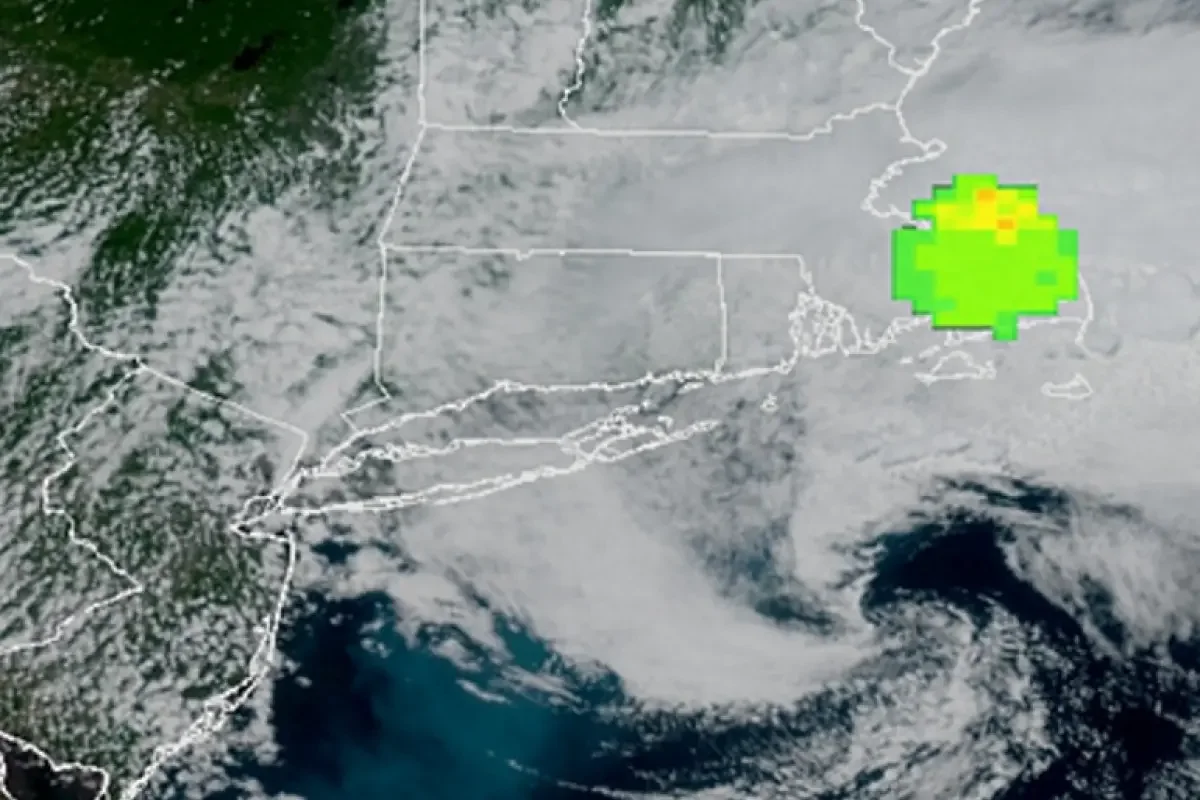
The mid-air explosion generated a double boom felt by residents from Delaware to Montreal, Canada, while weather satellites captured a distinct flash off the Massachusetts coast.
Scientific Confirmation
The U. S.
Geological Survey designated the occurrence as a widely felt sonic boom from a suspected bolide.
The agency noted that unlike earthquakes that happen at discrete subterranean locations, sonic boom events occur along a linear path in the atmosphere, explaining why no seismic activity registered on regional seismographs.
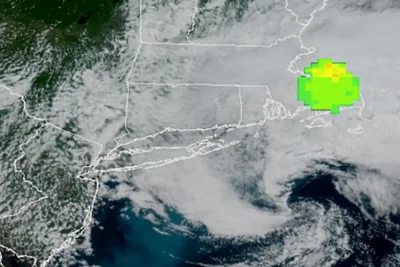
Data from the National Oceanic and Atmospheric Administration's GOES-19 weather satellite Geostationary Lightning Mapper detected an anomalous atmospheric burst east of Boston.
Spaceflight meteorologist Nick Stewart noted that the lightning satellite did not correlate the very large flash with active thunderstorms, confirming it as a distinctive signature of a meteor reentry.
NASA reported Saturday evening that the space rock fragmented at an altitude of 40 miles over northeast Massachusetts and southeast New Hampshire.
According to the federal agency, the breakup released an energy equivalent to approximately 300 tons of TNT, causing the loud noise.
Public Response and Safety
The Massachusetts Executive Office of Public Safety and Security confirmed that emergency and police departments across eastern Massachusetts were flooded with reports of audible booms and ground tremors.
State officials verified that no emergency police or fire requests were connected to the noise and no public safety threat existed.
Local weather officials and amateur radio networks also tracked the phenomenon.
The Southern New England Amateur Radio Skywarn, operating out of the National Weather Service Boston office in Norton, collected numerous reports of a large boom and ground-level shaking from Franklin, Massachusetts, through north-central Rhode Island.
Weston Observatory scientist Dr. John Eble explained that while space rocks frequently enter the atmosphere, they typically burn up completely.
He noted that larger fragments can generate a significant sonic boom audible to residents on the ground.
"It was definitely bigger than a normal fireball, about a yard wide," said Robert Lunsford, Fireball Program Monitor with the American Meteor Society.
Lunsford noted that the organization received dozens of reports from witnesses who observed a daytime fireball resembling a shooting star or felt the ground shake.
"We would need more information about the trajectory the speed and other aspects to know for sure if it hit the ground, but if it didn't burn up, then it would have landed in the ocean," Lunsford said.
He added that it is highly unlikely the meteor struck land, as most objects of this size burn up entirely before reaching the ground.
"This event is a widely felt sonic boom from a suspected bolide," wrote the USGS in an official alert.
The agency added context to the rarity of the event, stating that most sonic booms are not felt on land.
>>> TSA Arrests Armed Nassau County Volunteer Deputy at JFK Airport
"Unlike earthquakes which occur at discrete location in the earth, sonic boom events occur along a linear path in the atmosphere," the USGS stated.
The federal geological agency subsequently opened a dedicated event webpage due to the high volume of community inquiries.
"Appears to have fragmented at an altitude of 40 miles over northeast MA and southeast NH," NASA stated on social media.
The space agency provided a formal calculation regarding the physical forces involved in the atmospheric disintegration.
"The energy released at breakup is estimated to be equivalent to about 300 tons of TNT," NASA stated, "which accounts for the loud noise."
"This 'might' be a meteor that blew up in mid-air with a light streak observed per social media posts," posted SNE Amateur Radio Skywarn on X at 2:40 p.
m.
The volunteer storm spotter network verified that the USGS was not reporting an actual earthquake despite public speculation.
"The theory now is, and we don't know for sure, could this have been maybe an exploding meteor coming into the atmosphere.
That is kind of what we're investigating right now. We don't know for sure," said A.
J. Burnett, StormTeam 5 meteorologist.
Burnett stated that despite the lack of initial certainty, scientific data strongly suggested an exploding meteor rather than an earthquake.
"But the data suggests that that could be a very real possibility. I don't think this was an earthquake," Burnett said.
"... the whole house, actually all houses in the neighborhood shook.
Much louder than a transformer exploding and definitely not an earthquake," wrote one viewer from Melrose to WCVB.
Other residents across the region reported similar localized disruptions, with many initially suspecting property damage or falling trees.
"We live in Wellesley and just heard what sounded like an explosion about 10 minutes ago.
We understand it was felt over many areas," wrote another resident from Wellesley.
"We heard it in Newtonville and it was enough to set off the dog and make me think a big tree had come down because of the wind," stated a viewer from Newtonville.
"Although we do not yet know the cause, there are no known emergency police or fire requests connected to these reports and we do not believe there is any public safety threat," stated the Massachusetts Executive Office of Public Safety and Security.
State emergency management officials confirmed they remained in contact with local, state, and federal agencies to monitor the impact.
>>> ODOT Finalizes 2026 State Rail Plan Update, Seeks Public Input
"We remain in contact with our local, state, and federal partners to monitor any impact and understand the cause when it becomes available," the office stated.