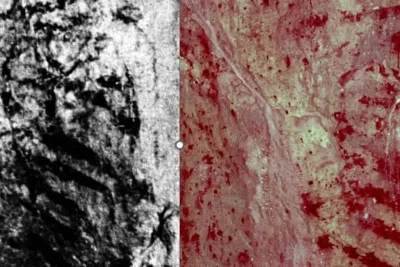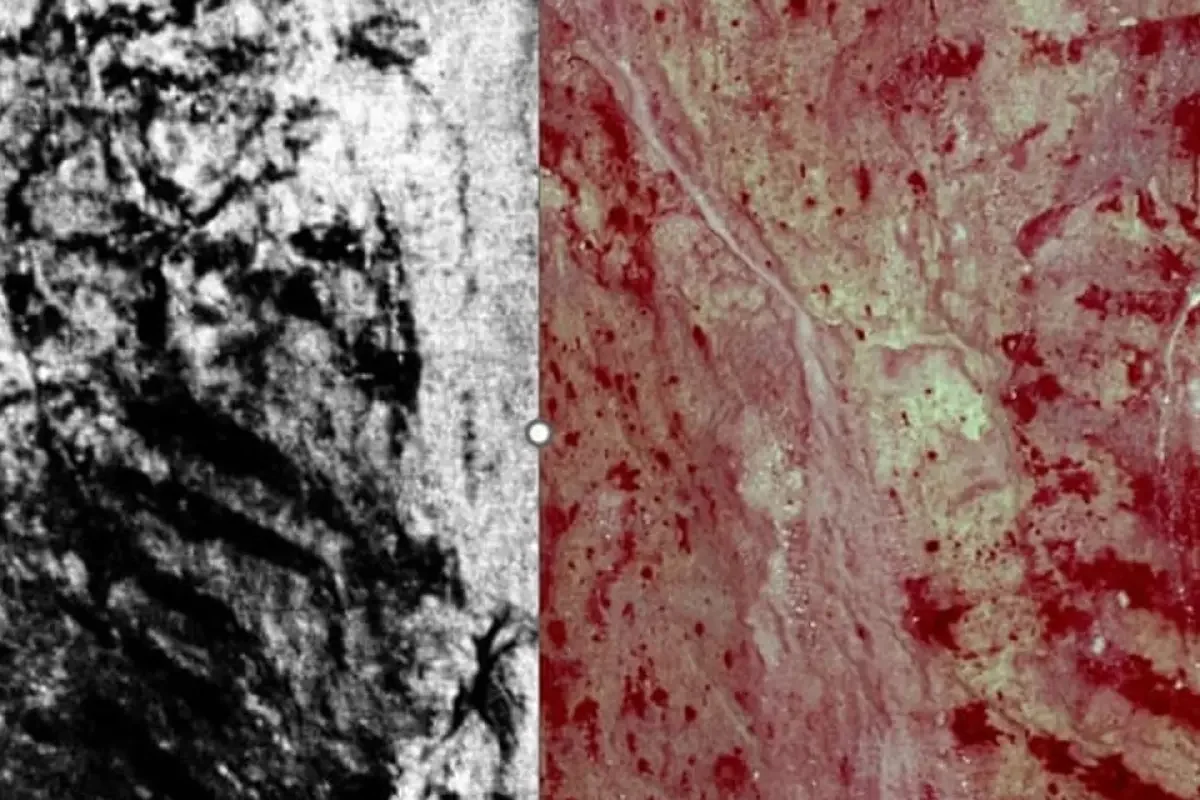
Red pigment bands on the walls of Bacon Hole cave in South Wales have been confirmed as Palaeolithic rock art dating back 17,100 years, according to new scientific analysis.
The discovery overturns a century-old dismissal of the markings as natural mineral stains.
>>> M6 Motorway Closed After Lorry Overturns Near Rugby
Rediscovery of Ancient Art
Archaeologists used uranium-thorium dating to analyze the pigments, establishing the site as the oldest known rock art in Britain and northwestern Europe.
Dr. George Nash, a British specialist in prehistoric art who led the international research team, said the finding was a significant breakthrough.
"This is the earliest prehistoric art we have in Britain," Nash stated.
The markings were first discovered in 1912 by professors William Sollas and Henri Breuil, who initially celebrated them as the first prehistoric cave painting in England.
However, by 1928, critics dismissed the panel, claiming the streaks were red oxide mineral seeping through the stone.
A local fisherman had also painted graffiti on the opposite side of the chamber in 1894, obscuring the full scope of the imagery.
Modern archaeometric analysis identified a specific pigment recipe containing clay residues and calcite, matching the local limestone geology.
Based on field observations and laboratory examination, the academics concluded that the pigmented lines were intentionally created by human agency, not natural processes.
"We concur with the original interpretation proposed by Breuil and Sollas in 1912," they added.
The painted lines are arranged horizontally and equidistant from one another, indicating a deliberate and structured pattern.
The study also showed that the ancient creators applied the paint using their fingers.
>>> Sky Radio Unveils Fresh Branding with New Logo and Slogans
Bacon Hole sits within the limestone cliffs of south Gower, overlooking the Bristol Channel.
The site is managed by the National Trust of Wales, which plans to officially announce the findings.
Though located in an area of outstanding natural beauty, the cave lacks scheduled monument protection. The research team argues that the site now warrants this official protective status.
Nash, an associate professor at the Geosciences Centre of Coimbra University in Portugal and honorary research fellow at the University of Liverpool, published the findings with international colleagues in the journal Quaternary.
The researchers noted that around 17,100 years ago, Wales was transitioning out of a severe cold phase of the Devensian glaciation.
The climate was gradually shifting from a frozen landscape to a treeless periglacial environment with sparse vegetation.
The area now occupied by the Bristol Channel would have served as a favorable catchment for migratory megafauna grazing during summer months.
Bacon Hole and other caves along the southern Gower coastline would have offered suitable habitation sites for hunter-fisher-gatherer groups.
The scientific organization First Art led the project alongside experts from the University of Southampton and Swansea University.
The initiative received support from the National Trust and the Bradshaw Foundation.
Upper Palaeolithic rock art remains exceptionally rare in Britain.
>>> London Underground Drivers Plan Strikes Over Compressed Work Weeks
The closest comparison is a 2010 discovery by Nash at Cathole Cave in Parkmill, about two and a half miles away, which dates back at least 12,500 to 14,500 years.