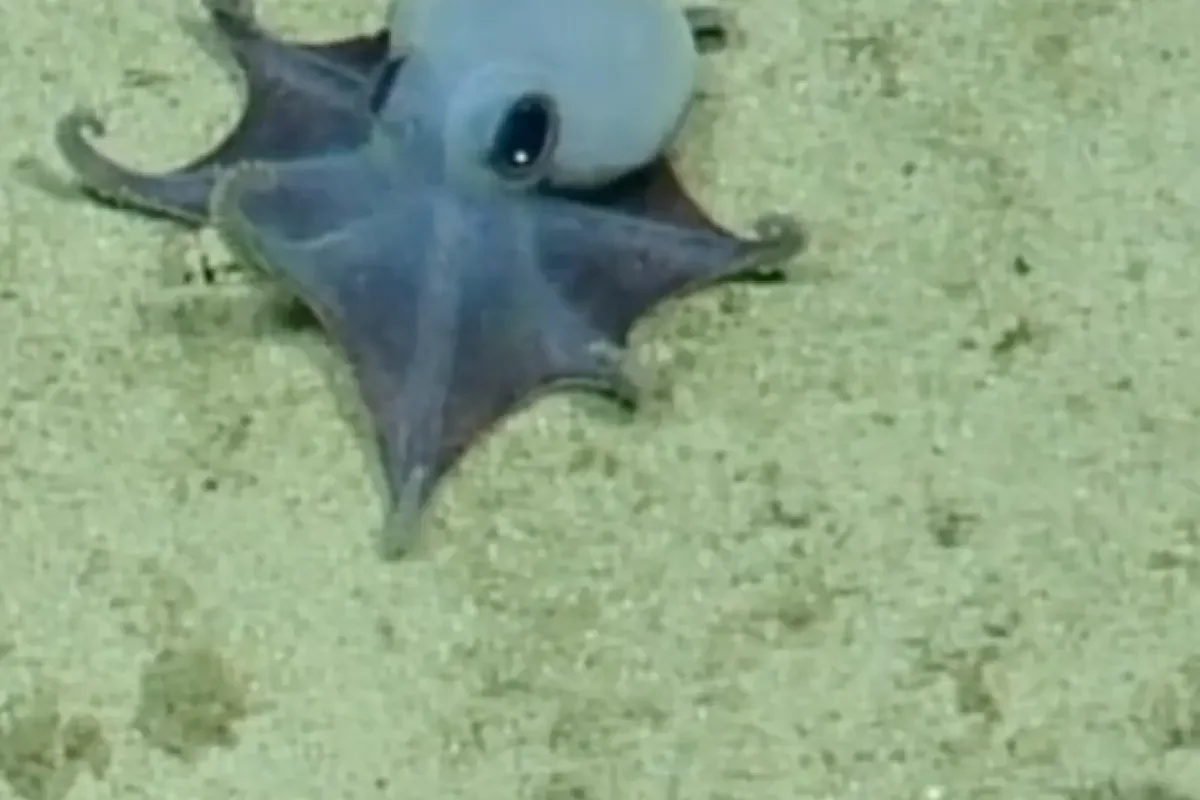
An international research team has identified a new species of tiny blue deep-sea octopus found near the Galapagos Islands, according to a study published in the scientific journal Zootaxa.
The golf ball-sized creature, officially named Microeledone galapagensis, was first collected at a depth of 5,800 feet near Darwin Island during a 2015 deep-sea expedition aboard the research vessel EV Nautilus.
>>> Dutton Ranch Breaks Paramount+ Streaming Record with 12.9 Million Views
The discovery challenges previous scientific consensus because related species in the Megaleledonidae family are typically much larger and live in the icy waters of Antarctica, while this specimen lacks an ink sac.
Because researchers secured only a single mature female specimen, the scientific team utilized advanced non-destructive micro-computed tomography scans at the Field Museum in Chicago to analyze its internal anatomy without dissection.
The advanced 3D imaging revealed the fine details of the animal's internal organs, including its mouth, teeth, beak, bipartite stomach, and internal eggs, confirming its status as a unique species.
Non-Destructive Imaging Preserves Rare Specimen
Janet Voight, curator emerita of invertebrates at the Field Museum of Natural History, led the scientific description of the animal after being contacted by researchers from the Charles Darwin Institute.
"I went through the photos and saw this one and it was like, wow, that is totally special," said Voight, noting that the creature stood out immediately during evaluation.
The single specimen had been preserved in alcohol and formalin before being sent to the Chicago museum, creating a unique challenge for anatomical examination.
"When you describe a new species of octopus, you have to look at all the parts, including the mouth, the beak and the teeth," explained Voight.
She noted that traditional methods would require cutting the rare specimen open, which she wanted to avoid.
"And to see those things, you have to cut the specimen open. We only had the one specimen, so I didn't want to take it apart," Voight added.
The CT imaging process allowed the team to virtually explore the specimen's internal structures while keeping the physical type specimen completely intact.
"These are little octopuses that live in the deep sea and hardly anybody on Earth has ever gotten to see them.
I just feel lucky that I got to work with them," said Voight.
She emphasized the vast scale of the marine environment that remains completely unmapped by researchers.
"If you took all the land on the Earth and pieced it together, you wouldn't cover the Pacific Ocean.
The oceans are so big and there's so much left to explore," Voight concluded.
Stephanie Smith, manager of the Field Museum's X-ray computed tomography laboratory, collaborated on the study to generate the non-destructive digital 3D models.
>>> Watchdog Finds Children Witness Extreme Violence in Custody Remand
"Because CT imaging is non-destructive, it's especially important for type specimens like this one," said Smith.
The technology compiles thousands of X-ray slices to view the internal systems of rare biological discoveries.
"And that's great for me because people are often bringing me these incredibly rare and stunningly beautiful specimens that I get the privilege of virtually opening up," Smith stated.
She expressed excitement about analyzing hidden biological structures that have never been seen before.
"There's nothing like spending the day looking at something no other human has ever seen," Smith remarked.
Alexander Ziegler, a researcher from the University of Bonn in Germany, analyzed the resulting high-resolution internal scans of the soft tissue structures.
"What really struck me was that the scan of the little octopus revealed so much information on its internal organ systems — usually, soft-part imaging using micro CT requires the use of heavy-metal-based contrast agents whose use would not be desirable with such a rare specimen," said Ziegler.
The high-contrast imaging permitted rapid digital reconstructions of the internal anatomy without chemical alteration.
"This made the 3D modeling of relevant organs really an easy task," Ziegler added.
Salome Buglass, a marine scientist from the University of California Los Angeles and former researcher at the Charles Darwin Foundation, co-authored the study after helping sort the expedition specimens.
"When we were sorting through dozens of specimens collected during the expedition, this tiny blue octopus fascinated us," said Buglass.
She recounted how the unique characteristics of the animal prompted the team to seek out international specialist support.
"There was something unusual about it, so we went out of our way to find the right person to help us identify what it was.
Getting the specimen to Janet was a long process, but one I would gladly repeat if it means getting to know the most precious parts of our ocean just a little bit better.
Discoveries like these remind us how much of the deep ocean in Galápagos remains unexplored.
Every new species helps us better understand these hidden ecosystems, and why protecting them matters," Buglass stated.
>>> Barnardo's Survey Reveals Widespread Online Harassment of UK Girls
The original expedition was a collaborative mission between the Charles Darwin Foundation, the Galápagos National Park Directorate, and the crew of the E/V Nautilus, who recorded video of two additional octopuses of the same species during the underwater mountain dive.