A new scientific analysis published in Nature Sustainability warns that rising sea levels and coastal erosion could surround New Orleans with open water by the end of this century, prompting experts to urge immediate relocation planning.
Coastal Louisiana faces a projected sea level rise of 10 to 23 feet, threatening to submerge 75% of remaining wetlands and push the shoreline inland by 62 miles.
>>> Tim Hortons to Hire 10,000 Local Workers, Reduce Foreign Labor
Researchers state that the low-lying region has already crossed the point of no return, forcing over 1 million residents into harm's way as local wetlands disappear at a rate of one football field every 100 minutes.
The study authors emphasize that delaying managed retreat will exhaust community resources and severely exacerbate economic inequalities for the city's most vulnerable populations.
Since Hurricane Katrina killed nearly 1,400 people in 2005, high flood risks have already caused New Orleans to lose approximately 25% of its total population.
"The main questions are how soon those futures will come, and how they will play out," said Benjamin Strauss, CEO and chief scientist at Climate Central.
Geological data from 125,000 years ago indicates that ancient shorelines sat 30 miles north of the city when ocean levels were 10 feet higher than today.
"It's very likely that sea level will rise to that elevation in the future," said Torbjörn Törnqvist, a report author and geology professor at Tulane University.
As the population shrinks, the remaining tax base erodes, causing public services to decline while local insurance premiums skyrocket.
"Eventually, yes, this is not going to be a livable place anymore," said Torbjörn Törnqvist, one of the paper's co-authors.
However, Törnqvist clarified that the city will not vanish immediately but will transform significantly due to the surrounding Gulf of Mexico.
"New Orleans is still going to be around by the end of the century," he said.
Socioeconomic data shows that the ongoing out-migration from southern Louisiana is driven by multiple factors, including changing employment landscapes for younger generations.
"What you notice in coastal Louisiana is the aging of the population.
Young people are leaving to go find jobs and places where they have more opportunities," said Beth Fussell, a sociologist and demographer at Brown University.
Fussell noted that this demographic shift is complex and extends beyond simple environmental awareness among residents.
"Most likely has nothing to do with their perception of environmental risk," said Beth Fussell.
Policy experts argue that re-skilling workforce populations early is necessary to prepare coastal communities for inevitable shifts in the regional economy.
"This is why starting early and planning now matters, because it takes such a long time to help people find new skills and new occupations," said Lawrence Huang, a policy analyst at the Migration Policy Institute.
The total disruption of urban infrastructure requires a proactive state strategy to prevent widespread economic hardship.
"We're going to have to re-skill people so that they can find jobs in their new location. That is the unfortunate reality," said Lawrence Huang.
Local advocates push back against the relocation narrative, stating that calls for abandonment ignore the historical resilience and cultural heritage of the population.
"As a native New Orleanian who lived through Hurricane Katrina, I found a lot of the framing surrounding that article incredibly irresponsible and honestly offensive to many people in this region," said Anna Nguyen, deputy director of The Water Collaborative.
Nguyen expressed that post-disaster commentary frequently diminishes the lived reality of residents who wish to protect their homes.
"After Katrina, many residents had to endure repeated national conversations suggesting that New Orleans should simply cease to exist or that people here should abandon their homes, culture, and communities.
Those narratives ignore both the lived reality and resilience of the people who call this place home," said Anna Nguyen.
Instead of discussing abandonment, local groups urge direct business investment in energy efficiency, rain gardens, and permeable surfaces to manage stormwater.
"The Water Collaborative is constantly looking to partner with businesses, institutions, and community organizations on our initiatives," said Anna Nguyen.
Private sector participation is viewed as vital for advancing regional workforce development and green infrastructure projects.
"Whether that's through sponsorships, advocacy efforts, workforce development programs, public education campaigns, or collaborative resilience projects, there are many ways for the private sector to be part of building a more sustainable and resilient future for our region," said Anna Nguyen.
Local advocacy groups emphasize that acknowledging environmental dangers should inspire infrastructure modernization rather than fatalism.
"That doesn't mean we ignore the realities of climate change or the very real risks facing coastal Louisiana," said Anna Nguyen.
Community discussions should prioritize active solutions to safely and equitably secure water management systems.
"We absolutely need honest conversations about sea level rise, land loss, subsidence, infrastructure vulnerability, and long-term adaptation.
But the conversation should center on what actions need to happen now to protect communities, modernize infrastructure, strengthen water management systems, and help residents adapt safely and equitably," said Anna Nguyen.
The expansion of green infrastructure tools serves as a primary defense against rising urban heat and heavy rainfall events.
"Parks, wetlands, permeable surfaces, trees, bioswales, and other green infrastructure solutions are not just environmental amenities," said Anna Nguyen.
These nature-based installations are critical assets for safeguarding public health and long-term urban stability.
"They are critical tools for managing stormwater, reducing heat, improving public health, and increasing long-term resilience," said Anna Nguyen.
Organizations intend to keep residents engaged in climate defense through solutions-oriented platforms.
>>> Massachusetts Observes Memorial Day with Closures and Cultural Events
"I believe organizations like The Water Collaborative have an important role to play in helping communities engage with these challenges in a way that is solutions-oriented rather than fatalistic," said Anna Nguyen.
Local business leaders also warn against the economic fallout of the abandonment narrative, citing the critical national role of South Louisiana in logistics and energy.
"More than 60% of America's natural gas is exported from southern Louisiana. New Orleans moves more than 90% of America's grain exports.
The Mississippi River is the logistical spine of the United States," wrote Michael Hecht, president and CEO of Greater New Orleans, Inc.
Hecht emphasized that the region relies on heavy infrastructure investments, including a $15 billion storm wall system, to defend its economic position.
"On an economic basis alone, New Orleans is essential," wrote Michael Hecht.
The focus remains on empirical research, structural improvements, and revised insurance policies to protect the city.
"Here in New Orleans, we are not climate deniers," said Michael Hecht.
The current strategy involves robust engineering defenses rather than retreating inland.
"For more than 300 years, New Orleans has defended its unique position, most recently with a $15bn storm wall system that kept the city bone-dry during a category five storm.
Much better than abandonment is the approach currently under way, including better infrastructure, revised policy (eg, insurance), as well as robust empirical research," said Michael Hecht.
While policy debates continue, local climate-tech startups are experiencing an increased sense of urgency to deploy innovative solutions for coastal preservation.
"There's nothing Louisiana knows better than water management," said Beaux Jones, president and CEO of The Water Institute.
Startups are focusing on regional expertise to scale technologies that mitigate severe land loss.
"We need to build on what we're good at," said Beaux Jones.
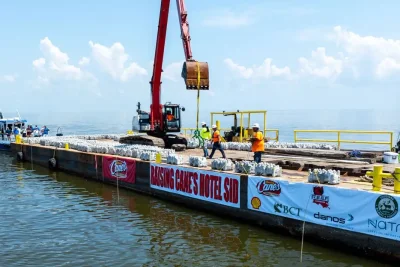
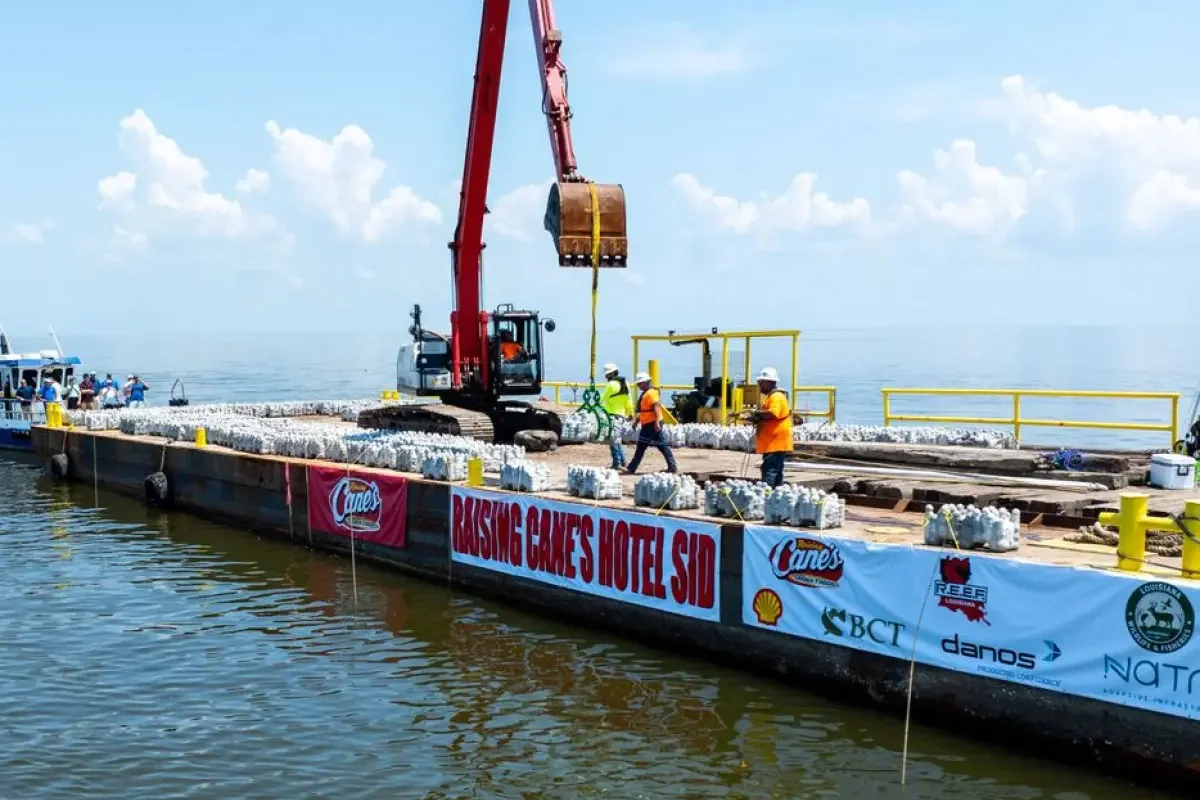
Companies like Natrx have raised $7 million to build lightweight, modular artificial reefs that mimic natural coastal protection systems.
"The process is analogous to how oyster shells or seashells are made," said Tad Schwendler, Natrx's chief operating officer.
These structures successfully promote marine life habitats while reducing heavy wave impacts on coastal industrial infrastructure.
"We designed permeable structures that slow the flow of water and create conditions that makes the sediment settle, the same way the marsh creates oyster reefs," said Tad Schwendler.
The growth of the coastal restoration industry allows local companies to test erosion models for global applications.
"Most of the world's resources are concentrated on coasts, and Louisiana can be the world leader in applying erosion solutions in the real world," said Tad Schwendler.
Simultaneously, data companies are utilizing advanced drone technology to measure real-time coastal erosion and assess environmental risks.
"My whole life, I've loved collecting data and building instruments," said Christy Swann, founder of RCoast.
The startup aims to help landowners and governments determine the effectiveness of various nature-based interventions.
"I'm addicted," said Christy Swann.
Data analytics show that nature-based defenses require precise planning and active seasonal management to remain viable.
"We'll recommend building sand fences at just the right angle to capture wind-blown sand during the windy season and then planting vegetation to stabilize the dune," said Christy Swann.
Adapting to severe weather patterns remains a primary objective for protecting local communities from major loss.
"Like farming, you have to work land that is constantly changing," said Christy Swann.
Predictive machine learning models are being developed to optimize mitigation strategies across changing shorelines.
"We know we have to adapt to increased storms and flooding, but we're not going to let New Orleans become Atlantis," said Christy Swann.
In addition to technological innovations, historical precedents of community relocation exist globally, providing frameworks for managed climate migration.
The town of Kiruna in Sweden is currently undergoing a decades-long relocation due to structural damage from an expanding mine.
"It is a big sorrow to leave everything, and I think that is important to understand that," said Clara Nyström, Kiruna's municipal heritage officer.
Despite the emotional difficulties of relocation, urban sustainability experts believe that safe new communities can be built without sacrificing local culture.
"If the writing is on the wall that we need to go eventually, do we want to wait until people's resources are exhausted and there's a crisis?"
asked Brianna Castro, an assistant professor of urban sustainability at Yale School of the Environment.
>>> Thunder Bay Under Dense Fog Advisory as Temperatures Set to Rise
Amidst ongoing debates, the cancellation of major nature-based initiatives like the Mid-Barataria Sediment Diversion project highlights how political shifts continue to impact Louisiana's long-term coastal survival strategies.