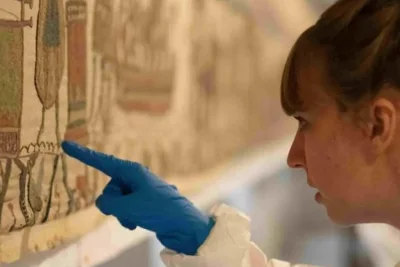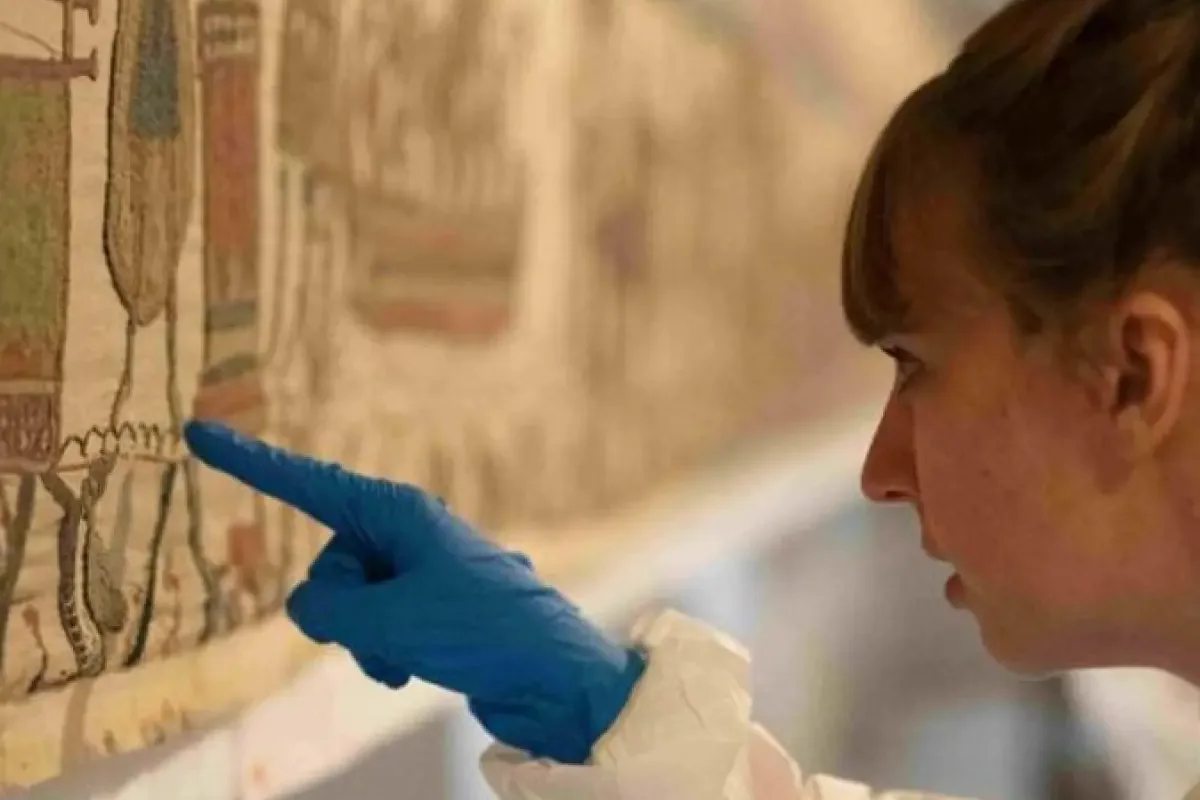
The 950-year-old Bayeux Tapestry will travel from France to London for a nine-month exhibition at the British Museum starting September 10, 2026.
The loan follows a bilateral agreement announced by French President Emmanuel Macron in 2025.
>>> Marjane Satrapi, Acclaimed 'Persepolis' Author, Dies at 56
The artifact, an 11th-century linen embroidery depicting the Norman Conquest of England in 1066, will leave its home in Bayeux for only the third time in history.
Its permanent venue is undergoing major renovations.
To protect the fragile 70-meter-long textile, experts designed a specialized temperature-regulated aluminum transport cradle.
Metal springs act as shock absorbers to neutralize transit vibrations during the 560-kilometer journey via the Channel Tunnel.
Technical Preparations and Security
French cultural officials expressed confidence in the security and technical measures. Delphine Christophe, the ministry's head of heritage and architecture, said, "I am extremely serene."
Dual test runs using facsimile reproductions in February and April successfully proved that up to 96 percent of vertical vibrations are absorbed.
"Nothing has been left to chance," said French Culture Minister Catherine Pégard.
The transport will use a double-crate containment system to safeguard fibers against humidity fluctuations and physical impacts.
"All and any vibration that could pose a risk to the fibres of the tapestry will be absorbed," Pégard added.
French authorities are keeping exact logistics and mid-July transit dates confidential for maximum security.
"Never in the history of moving such an object have so many test runs been carried out. Everything has been thought of," Pégard said.
The minister acknowledged objections from conservation groups and art historians.
"Some people ask if we have the right to move this precious object key to our history and I understand them," she said, adding that the work "lives through the eyes of those who see it."
Diplomatic Exchange and Display
The United Kingdom will send major historical treasures, including the 12th-century Lewis chess pieces and Sutton Hoo artifacts, to Normandy museums.
Pégard said the loan will "allow the English people to contemplate on their own soil the act that was the birth of their nation."
British diplomats guaranteed the artifact's security and return.
>>> Armed Robber Flees After Targeting Hoogezand Gas Station
"Yes, of course we will give the tapestry back, safe and sound," said Lord Peter Ricketts, former British ambassador to France and UK special envoy.
The tapestry is to be returned by July 11, 2027.
The British Museum will display the embroidery flat in its full continuous length inside a custom-engineered exhibition case alongside contemporary historical manuscripts.
"And we will entirely guarantee the protection of this precious work for the time it is with us," Ricketts said.
The artifact features 58 stitched scenes containing 623 human figures, 700 animals, and dozens of vessels detailing the Battle of Hastings.
Ricketts noted the tapestry's central role in British identity, tracing the fall of King Harold during the Norman invasion.
"Because it is central to our national story," he said.
Technical specialists explained how the cradle mechanism dampens movement during transport.
"The idea is that the vertical shocks which will occur are transformed into horizontal shocks, causing the inner crate to rock to and fro like a baby in a cradle," said Cecilia Gauvin, an art conservation expert.
Engineering data revealed that baseline ambient vibrations occur in public gallery spaces even without moving displays.
"Don't forget an artwork receives vibrations merely from the footsteps of all the visitors to a museum," said Kerstin Kracht, a vibration reduction expert.
Prominent art critics continue to challenge safety claims, citing risks from the sub-sea rail shuttle.
"What happens if there is a problem in the tunnel and the lorry gets stuck there?
These technical reports they have produced are meaningless," said Didier Rykner, a leading French arts writer.
The original embroidery is believed to have been commissioned by Bishop Odo of Bayeux in the 1070s.
>>> Ridley Scott's 'Kingdom of Heaven' Now Streaming on Peacock After Cult Revival
It was rediscovered inside Bayeux Cathedral during the 1800s before modern preservation began.