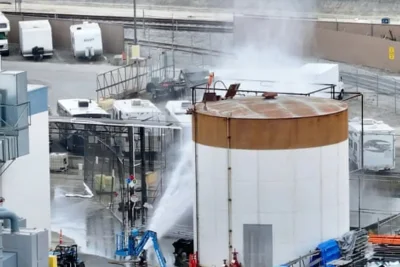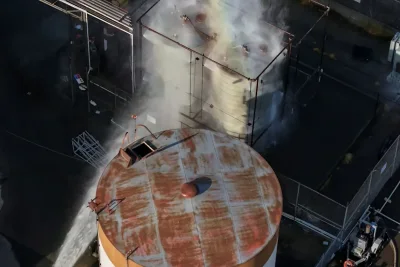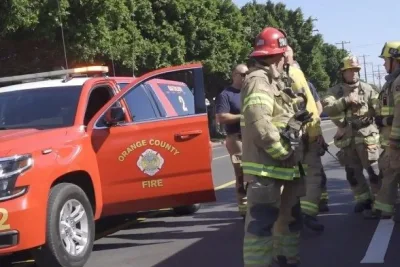
A suspected cooling system failure at the GKN Aerospace facility in Garden Grove forced 50,000 Orange County residents to evacuate last weekend, triggering severe financial hardships for local families and small businesses.
The economic impact of the five-day shutdown has left numerous commercial establishments reeling from forced closures.
>>> Netflix Documentary 'The Crash' Sparks Debate Over Ohio Teen's Fatal Car Crash
Several businesses reported individual losses exceeding $10,000, while others faced much steeper deficits due to ruined inventory ahead of a major holiday weekend.
Emergency officials confirmed that the immediate danger decreased as the 34,000-gallon tank containing highly reactive methyl methacrylate (MMA) began cooling.
The containment zone was subsequently reduced to a 300-foot radius around the structure, successfully clearing all residential properties from the perimeter.
Environmental agencies and local health departments are now shifting their focus toward long-term remediation.
The tracking of air quality remains a point of discussion between federal regulators and local health officials regarding potential chemical exposure during the peak of the crisis.
"We will work with Orange County Health, and the EPA will work with the company on the removal of the waste," said Mike Yeun, Deputy Incident Commander.
Local restaurant operators expressed devastation over the timing of the facility emergency, which disrupted their busiest seasonal operations.
Establishments had heavily invested in fresh inventory that ultimately had to be discarded during the evacuation period.
"We had things stocked up for the Memorial Day weekend rush," said Evodio Pantaleon, a diner worker at Harry's Cafe.
"Tomatoes, lettuce for burgers, chicken, steak, everything had to be thrown away."
Displaced residents also faced compounding personal expenses due to regional hotel shortages caused by the mass exodus.
Families were forced to secure accommodations miles away from their neighborhood, leading to high travel costs.
"Minimum $1,000.
I can only imagine how much more in the smaller expenses I had to do," said James Abilez, an evacuated resident.
The displacement forced families into neighboring areas, which significantly increased their daily commuting burdens. Many had to navigate these logistical hurdles while simultaneously managing regular employment obligations.
"We were in Ontario, Corona, so we were traveling about 30 miles away just to get a hotel for that one night if we're lucky," said Abilez.
Corporate Response and Investigation
In response to the community disruption, corporate leadership issued a formal apology regarding the operational failure.
>>> Met Office Forecasts Cooling Trend Following Record Breaking Heatwave
The manufacturing firm committed to investigating the root cause of the hazardous chemical reaction.
"On behalf of the team at GKN Aerospace, I want to say how sorry we are for the uncertainty and disruption this situation has caused," said Steve Carlin, GKN Senior Vice President.
The company emphasized its awareness of the severe timing of the incident, which overlapped with regional holiday plans.
Corporate representatives stated they would look into avenues to assist the impacted community.
"I recognize how challenging this has been, particularly over the Memorial Day holiday.
We are committed to understanding what occurred and identifying ways we can support those affected," said Carlin.
The incident raised broader industry-wide questions regarding the management of highly reactive hazardous materials.
Technical experts noted that cooling system anomalies frequently serve as the primary catalyst for dangerous chemical chain reactions.
"We don't know why, but it stopped cooling," said TJ McGovern, Orange County Fire Authority Interim Chief.
"So that's what started this event, to where the product heated up and it off-gassed through the relief valve, and that's how this whole response started.
We're just now being able to get to the tanks, so there's definitely more to come of what caused it."
Chemical experts explained that uncontrolled thermal polymerization creates an accelerating cycle of heat generation.
This specific scientific phenomenon poses severe risks to structural containment vessels and public safety if left unmitigated.
"It produces heat, and then in producing that heat, it furthers the chain reaction, so it keeps going and going and going," said Elaine Villanueva Bernal, a lecturer at Cal State Long Beach's department of chemistry and biochemistry.
Historical data from the U. S.
Chemical Safety and Hazard Investigation Board indicates that rapid polymerization accounts for a significant portion of domestic chemical incidents.
>>> Pilot Dies After Single-Engine Plane Crash at Saratoga County Airport
Industry safety studies consistently emphasize the critical importance of robust process designs to prevent catastrophic thermal runaway events.