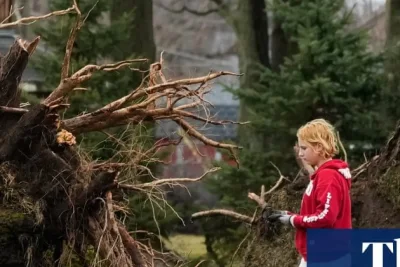
A severe escalation in dust storms and blowing dust events is affecting multiple regions across the United States as prolonged drought, record heat, and intense spring winds destabilize topsoil.
Data analyzed by NOAA scientists reveals that dust storm occurrences in the Southwest more than doubled between the 1990s and the 2000s, marking an increase of 240%.
>>> Netherlands Braces for Record Heat as Heatwave Nears Brabant
The National Weather Service in Grand Forks recently issued both a Dust Storm Warning and a Blowing Dust Warning simultaneously for the first time in its history due to near-zero visibility.
Health officials are increasingly concerned about the medical impacts as dangerous particulate matter enters the atmosphere.
"Breathing in high levels of particulate matter can lead to inflammation and exacerbate a wide range of health problems," said Estrella Herrera, a University of California researcher.
According to Herrera's research, hospitalizations can increase fivefold following a dust storm event in Texas, with young children, the elderly, and individuals with asthma or bronchitis facing the highest risks.
An uptick in Valley Fever cases, a fungal infection endemic to the dusty Southwest, is also being linked to dust storms spreading soil-borne spores.
Regional Impact and Agricultural Concerns
Arizona leads the nation in dust storm activity, with the Phoenix area experiencing one to three massive haboobs annually and recording 189 dust events over 13 years.
In Texas, El Paso experienced its worst dust storm season since the 1930s Dust Bowl in 2025, while New Mexico recorded 50 dust storm events between January 1 and March 31, 2025.
California is also heavily impacted, with dust events in the Central Valley rising by approximately 0.41% per decade between 2008 and 2022, driven largely by agricultural land fallowing.
>>> Multiple Earthquakes Shake Coastal California on Monday
In Utah, receding water levels of the Great Salt Lake have exposed dry lake beds, generating toxic dust storms with elevated arsenic levels exceeding EPA residential soil standards.
The issue has expanded into the Midwest, where strong winds, dust storms, and wildfire smoke forced Oklahoma to declare a state of emergency in March 2025 due to poor air quality.
Agricultural sectors are experiencing direct impacts, prompting Midwest farmers to raise alarms over soil stability and nutrient loss from intensive tillage.
"There have been so many dust storms this spring, the worst I’ve ever seen," said Jim Reed, an Illinois farmer.
"That should have everybody concerned."
Reed noted that cover crops and no-till farming, incentivized by rising fuel costs, are expanding as mitigation strategies against wind erosion.
"It seems to correlate to the adoption of high-speed discs," Reed said, observing that neighbors who managed fields in the fall without repeating in the spring saw less dust blowing.
Long-term climate projections in the journal Nature indicate these arid conditions could persist through the century due to global heating.
>>> Trouw Columnist Sylvain Ephimenco Departs After Editorial Dispute Over Migration Column
"Water managers need to plan for the possibility that this drought isn’t just a rough patch – it could be the new reality," warned Timothy Shanahan, a researcher at the University of Texas at Austin.