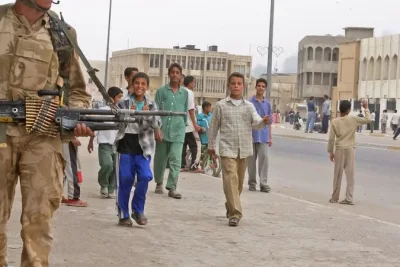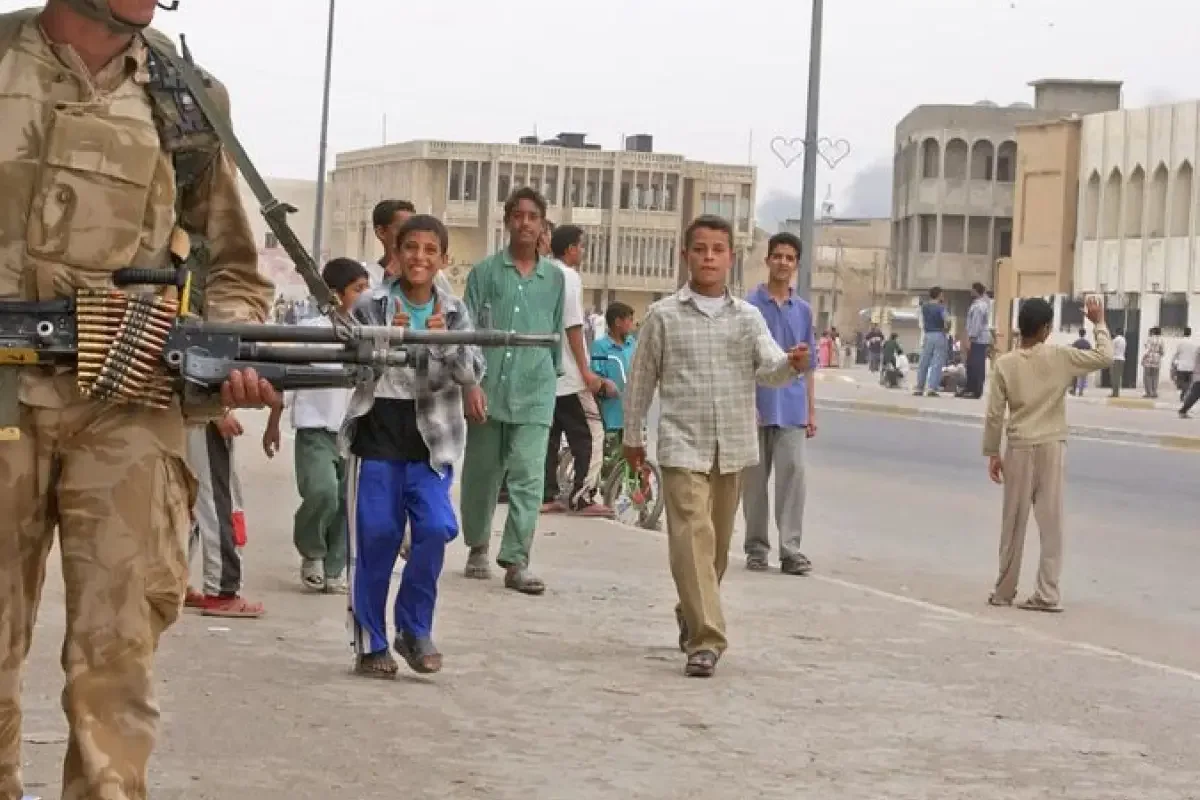
Around 1,500 veterans, families, and officials gathered at the National Memorial Arboretum in Staffordshire on Friday to commemorate the 15th anniversary of the conclusion of British military combat operations in Iraq.
The event, titled 'Remembering Iraq: 15 Years On' and organized by the Royal British Legion, honored the service of approximately 140,000 British troops deployed during Operation TELIC.
>>> Thanet District Council Advances Margate Theatre Regeneration Projects
Official records show that 179 British Armed Forces personnel or Ministry of Defence civilians died during the conflict, with 136 dying in theatre, while more than 6,000 sustained injuries.
Veterans Share Personal Experiences
James Houghton, a Lincolnshire veteran who deployed to Iraq for six months in 2003 to maintain tank transporters, emphasized the critical need for historical awareness regarding modern military actions.
"Going out to Iraq was scary as it was going into the unknown and we were out there quite early on with limited comms, basic reporting and in a really oppressive environment due to the heat," said Houghton.
Houghton recalled working non-stop on the Oshkosh Tank Transporters, noting that his friend, Corporal Richard Ivell, died in a vehicle accident during the campaign.
"Working on the Oshkosh Tank Transporters, we didn't really have much down time at all as we were the only tank transport squadron in theatre at the time," he said.
He stated that modern conflicts are often omitted from history lessons and expressed hope that the public would recognize the sacrifices made.
"If there was heavy equipment that needed moving, we had guys on the ground seven days a week 24/7.
It was non-stop for six months and our role was crucial to keeping everyone moving," said Houghton.
Houghton reiterated that the event serves as an essential tool to highlight the deployment and educate the broader populace.
"I feel it is important to remember recent conflicts and mark the service of those involved," he said.
He concluded his thoughts by urging a structural change in how recent military history is preserved and shared.
"We all go out to do a job, and the Iraq war, as with other modern conflicts, isn't really taught in history lessons or marked as much as other periods in history," said Houghton.
Houghton hopes the collective gathering will permanently solidify the legacy of those who served.
"I hope this event will put highlight the service of those that went out to Iraq and educate the wider public," he said.
Rikki Drury, an 18-year-old soldier from Redcar when deployed, reflected on the shock of fighting an unconventional insurgency without properly armored vehicles, leading to his ongoing struggle with post-traumatic stress disorder.
"We didn't have the armoured vehicles, we were driving around with no armour," said Drury.
Drury, who now works with the group Healthier Heroes in East Cleveland, noted that the initial justification regarding weapons of mass destruction proved false.
"When you're fighting an insurgency, anyone is your enemy," he said.
He expressed deep personal sorrow regarding the lasting mental health toll of the campaign.
"The hardest war to fight is one where someone is not in a uniform. We weren't expecting that kind of warfare," said Drury.
Drury noted that the human cost remains a painful reality for many survivors.
"It's heartbreaking to think I'm suffering with my mental health for the rest of my life for a war that achieved nothing in my eyes," he said.
He concluded that many individuals made the ultimate sacrifice based on intelligence that was ultimately found to be non-existent.
"Others have lost their lives for weapons of mass destruction that were never found," said Drury.
Dominic Conway, a Royal Marine from Whitley Bay who was among the first troops to enter Iraq, stated that initial resistance was light before the unexpected, prolonged insurgency developed.
>>> Paramount Fires Tom Hardy From MobLand Over On-Set Tensions
"Resistance was there but it wasn't particularly heavy," said Conway.
Conway believed their primary mission as Marines was achieved before transferring responsibilities to the main army units.
"It seemed the job was done, the insurgency that followed and all the years it carried on for, I don't think that was really anticipated," he said.
He explained the specific operational methodology of his branch during the early invasion phase.
"We were there to do the initial assault and, as Marines, that's our job.
We come across the horizon, we do the job and hand over to the big army," said Conway.
Conway maintained that protecting vulnerable populations from Saddam Hussein's regime justified the deployment, despite the political discrepancies regarding the initial intelligence.
"Do I think the sacrifice was worth it?
Yes, I probably do in terms of we were there to protect people who couldn't protect themselves," he said.
He recognized the humanitarian aspect of removing a dictator who targeted his own citizens.
"Saddam did some really nasty things to the Kurds and his own people and so in that respect we did go for the right reasons," said Conway.
Conway noted that the subsequent political narrative differed significantly from the realities on the ground.
"Politically, it wasn't particularly for the reasons we were told at the time," he said.
Legacy of the Conflict
Forces News reported that the Iraq conflict fundamentally changed modern warfare through the widespread proliferation of Improvised Explosive Devices (IEDs).
The Iraq inquiry recorded a significant escalation in IED threats starting in July 2003, with former US Lieutenant General Michael Oates noting that incidents peaked at 4,000 per month, utilizing advanced military-grade munitions left from the previous regime.
Corporal Ryan Alexander of the 1st Battalion The Royal Anglian Regiment explained to the National Army Museum how rapidly the technological threat evolved in Basra, rendering early vehicles like the Snatch Land Rover highly vulnerable.
"When I arrived, roadside bombs, improvised explosive devices, there was probably one every week to 10 days.
By the time I left Iraq, four, five months later, whatever it was, there was probably one a day in Basra," said Alexander.
Alexander noted that subsequent deployments faced vastly superior, specialized explosive threats.
"By the time my battalion went out there – I didn't go with my battalion – a year later, there was several every day, and they'd improved the technology to be these explosively formed projectiles which could pierce all our armoured vehicles," he said.
A House of Commons Defence Select Committee report from 2006 confirmed that the lightly armored Snatch Land Rovers, nicknamed 'mobile coffins,' accounted for nearly half of UK hostile fatalities between July 2004 and July 2006, leading the Ministry of Defence to introduce the Foxhound vehicle in 2010.
The strategic legacy of the war also featured heavy armor success, such as the Royal Scots Dragoon Guards destroying 14 Iraqi tanks using Challenger 2 vehicles in March 2003.
According to Chatham House, the UK later donated 14 Challenger 2 tanks to Ukraine in January 2023, a move described by former Ukrainian Prime Minister Arseniy Yatsenyuk as a definitive Western gamechanger.
"Your decision to provide Storm Shadow missiles and Challenger tanks to Ukraine was the sea change.
It was a gamechanger in the decision-making process of the entire West," said Yatsenyuk.
>>> Judge Discharges Jury in Ian Watkins Prison Murder Trial
The military charity SSAFA released an official statement marking the anniversary of the formal closure of Operation TELIC on May 22, 2011, pledging continuous long-term support for veterans navigating the transition to civilian life.